Vacuum Pump Technologies & Pump Types
Vacuum Pumps UK supplies and supports a broad range of industrial
vacuum pumps, low-pressure compressors, blowers and engineered
vacuum systems.
The correct technology depends on the airflow, vacuum or pressure
required, the operating duty, the process conditions and the gas
or vapour being handled. Our team can help compare the available
technologies and select the most appropriate pump for a new
installation or replacement application.
Choosing the Correct Technology
Pump size is only one part of the decision. These four factors normally determine which operating principle is most suitable.
The volume of air or gas that must be moved at the required operating pressure.
The actual working level, not only the pump’s quoted ultimate performance.
Continuous running, intermittent cycles, evacuation time and standby requirements.
Moisture, vapour, dust, temperature, contamination and the gas being handled.
Different Pump Types Suit Different Applications
There is no single vacuum pump technology that is best for every application. A dry-running vane pump may be ideal for clean machine air, an oil-lubricated pump may be needed for a deeper vacuum, a side-channel blower may provide the required high airflow, while a claw, screw or central system may offer the best long-term solution for a demanding production process.

Dry-Running Rotary Vane Pumps
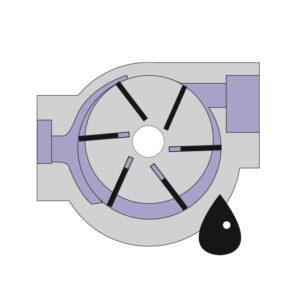
An eccentrically mounted rotor turns inside a cylindrical pumping chamber. Self-lubricating carbon or composite vanes slide within slots in the rotor, forming moving chambers that draw air through the inlet and discharge it through the outlet.
Because no oil is used within the pumping chamber, this technology provides clean vacuum or low-pressure air without routine oil changes. Dry-running vane pumps are best suited to clean, dry air and should be protected from liquid carry-over, oil and process contamination.
Typical uses: printing and paper handling, packaging machinery, lifting, clamping, conveying and general industrial equipment.
Oil-Lubricated Rotary Vane Pumps
Oil-lubricated rotary vane pumps use an eccentric rotor and sliding vanes, with oil circulating through the pumping mechanism to lubricate moving components, seal internal clearances and help remove heat.
The improved internal sealing enables lower final pressures than most dry-running vane pumps. Gas ballast improves the handling of water vapour by reducing condensation inside the pump, while specialist water-resistant versions are available for processes containing higher vapour loads.
Typical uses: vacuum packaging, food processing, thermoforming, degassing, lifting, central vacuum and machinery requiring a deeper working vacuum.
Dry Claw Vacuum Pumps and Compressors
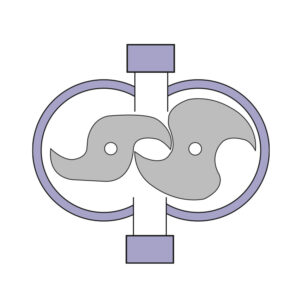
Two claw-shaped rotors turn in opposite directions inside the pumping chamber. Precision timing gears keep the rotors synchronised so that they do not contact one another or the pump housing.
No oil is required within the pumping chamber. Oil may still be used in the separate gearbox and bearing compartments. The non-contact pumping mechanism eliminates carbon vane wear and can provide efficient, dependable operation with reduced routine maintenance.
Typical uses: packaging, food processing, pneumatic conveying, printing, woodworking, plastics and centralised vacuum or pressure systems.
Side-Channel Blowers
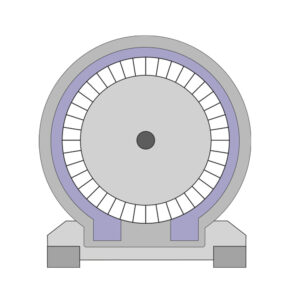
A high-speed impeller rotates inside a shaped housing without contacting it. Air entering the blower is repeatedly accelerated through the side channel, progressively increasing the pressure difference between the inlet and outlet.
Side-channel blowers provide relatively high airflow at moderate vacuum or pressure levels. The contact-free operating principle produces clean, non-pulsating air and requires little routine maintenance. Correct sizing and suitable limiting or relief valves are important because the conveyed air also cools the blower.
Typical uses: aeration, pneumatic conveying, printing and paper handling, drying, air knives, packaging and high-airflow vacuum or pressure duties.
Piston Vacuum Pumps and Compressors
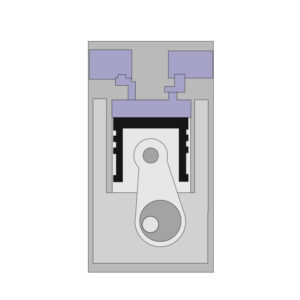
A piston moves backwards and forwards inside a cylinder. Inlet and outlet valves control the direction of airflow, drawing air into the cylinder during the suction stroke and discharging it during the compression stroke.
Piston pumps are robust, compact and particularly useful for relatively low-flow vacuum or pressure duties. Suitable models can tolerate moisture better than many dry-running vane pumps. When used as compressors, the airflow is naturally pulsating, so a receiver may be required where a smoother supply is needed.
Typical uses: medical equipment, analytical and laboratory instruments, portable units, sampling systems and specialist low-flow machinery.
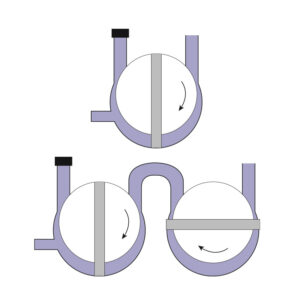
Oil-Sealed and High-Vacuum Rotary Vane Pumps
Oil-sealed high-vacuum pumps use rotary-vane technology with oil providing lubrication, cooling and internal sealing. Two-stage pumps connect two pumping stages in series, enabling a lower ultimate pressure than a comparable single-stage pump.
Gas ballast improves water-vapour tolerance by reducing condensation inside the pump, but the unit must remain within the manufacturer’s stated vapour-handling and pressure limits. Some high-vacuum pumps should not be operated continuously at atmospheric pressure.
Typical uses: sealed-vessel evacuation, refrigeration servicing, laboratory and research equipment, freeze drying and backing duties for higher-vacuum technologies.
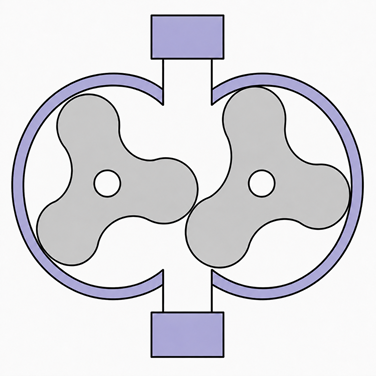
Lobe and Roots Booster Pumps
Lobe or Roots booster pumps use two synchronised, non-contact rotors to move large volumes of gas. In vacuum applications they normally operate in series with a primary backing pump rather than as a stand-alone vacuum pump.
Adding a booster can substantially increase pumping speed at lower operating pressures, reduce evacuation time and allow the combined system to reach a lower final pressure than the backing pump alone. Correct control and protection are essential when matching the booster to the primary pump and process.
Typical uses: food and pharmaceutical processing, transformer drying, degassing, heat treatment and larger high-capacity process systems.

Engineered Vacuum and Pressure Systems
A vacuum system may be as simple as a pump with an inlet filter,
receiver and control valve, or a fully centralised installation
serving multiple production machines.
Correctly designed central systems can maintain production while
an individual pump is isolated for maintenance, reduce duplicated
equipment around the factory and operate only the pumping capacity
required by current demand.
Not Sure Which Pump Technology Is Right?
Send us the existing pump model or nameplate, required airflow, operating vacuum or pressure, duty cycle and details of the gas, vapour or contamination present. Our technical team will help compare the available pump types.