

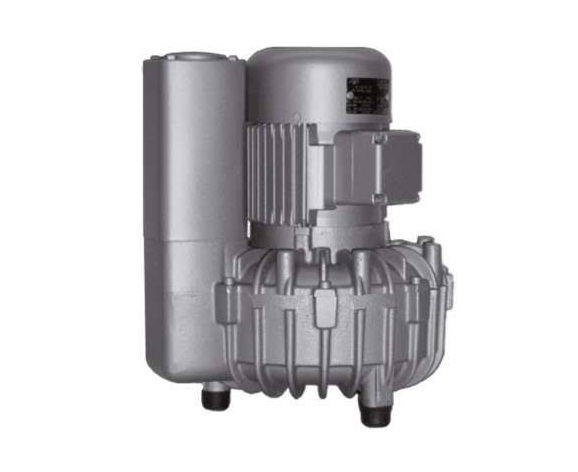
Becker SV 8.160/2 1.5kW Side Channel Blower
The Becker SV 8.160/2 is a two-stage side channel blower delivering 75 m³/h nominal capacity at 50 Hz, with maximum relative vacuum of -300 mbar and maximum positive pressure of +400 mbar.
Powered by a 1.5kW motor, the SV 8.160/2 is configured for applications where relatively modest airflow must be combined with useful vacuum or positive-pressure differential. Its two-stage regenerative arrangement enables substantially greater differential than would normally be required for simple low-pressure air movement.
The blower develops vacuum and pressure without rubbing carbon vanes and without lubricating oil within the process-air chamber. This non-contact regenerative principle provides an oil-free air path for suitable machine vacuum, handling, blowing, drying and process-air applications.
Becker side channel blower supply and technical support from Vacuum Pumps UK.

Replacing a Becker SV 8.160/2?
Send us photographs of the complete blower together with clear images of the Becker identification plate and electric motor nameplate.
Knowing whether the blower operates on vacuum or pressure and the normal working differential can help us assess the replacement requirement.
Blower Type
Two Stage
side channel blower
Nominal Capacity
75 m³/h
at 50 Hz
Maximum Vacuum
-300 mbar
relative at 50 Hz
Maximum Pressure
+400 mbar
relative at 50 Hz
Motor Power
1.5kW
50 Hz motor
Compact Two-Stage Performance from the SV 8.160/2
The Becker SV 8.160/2 combines 75 m³/h nominal capacity with maximum relative vacuum of -300 mbar and maximum positive pressure of +400 mbar. The balance of these figures is important: this is not primarily a high-volume blower, but a two-stage configuration intended to provide useful airflow while developing considerably greater differential.
On suction-side applications, the -300 mbar maximum relative vacuum provides capability for machine vacuum, holding and handling duties where a stronger pressure difference is required. Used on its discharge side, the +400 mbar maximum positive pressure enables the blower to deliver air against more substantial system resistance.
This makes the SV 8.160/2 particularly relevant where the required air volume is moderate but the application includes restrictive tooling, pipework, filtration or process resistance. In these circumstances, differential capability may be more important than selecting a blower simply from its free-air capacity.
The two-stage regenerative design progressively transfers energy to the air through successive side channel stages. The rotating impeller accelerates the air repeatedly as it travels through the blower, allowing the total vacuum or pressure differential to build before the air leaves the unit.
There are no rubbing carbon vanes within the compression process and lubricating oil is not required within the process-air chamber. This provides an oil-free air path for suitable industrial applications while retaining the higher differential capability associated with the two-stage arrangement.
Becker SV 8.160/2 Technical Specification
This 1.5kW SV 8.160/2 configuration provides 75 m³/h nominal capacity at 50 Hz, with maximum relative vacuum of -300 mbar and maximum relative positive pressure of +400 mbar.
| Model | Stage | Nominal Capacity 50 Hz |
Maximum Vacuum | Maximum Pressure | Motor Power |
| SV 8.160/2 | Two Stage | 75 m³/h | -300 mbar | +400 mbar | 1.5kW |
The 75 m³/h nominal capacity and maximum -300 mbar vacuum and +400 mbar pressure figures describe different points within the blower’s performance range. They are not simultaneous performance figures.
As system resistance increases, the vacuum or pressure differential developed by the blower rises while the available airflow changes along its performance characteristic. Selection should therefore be based on the required air volume at the intended working differential.
This is especially relevant for the SV 8.160/2 because its two-stage arrangement provides substantially greater differential than its nominal airflow figure alone might suggest. When replacing or selecting the blower, both airflow and the resistance of the connected system need to be considered.
SV 8.160/2 Performance Characteristics
75 m³/h Airflow
Moderate nominal capacity suited to machine and process applications where differential capability is more important than very high air volume.
-300 mbar Vacuum
Useful two-stage suction capability for handling, machine vacuum and applications operating against appreciable resistance.
+400 mbar Pressure
Strong positive-pressure capability for blowing, process air and suitable conveying duties with restrictive system conditions.
Two-Stage Design
Successive regenerative stages allow greater vacuum and pressure differential to be developed from the available motor power.
1.5kW Motor
This SV 8.160/2 configuration uses a 1.5kW electric motor at 50 Hz to provide its specified two-stage performance.
Non-Contact Compression
The regenerative process requires neither rubbing carbon vanes nor lubricating oil within the process-air chamber.
Applications for the Becker SV 8.160/2
The SV 8.160/2 is particularly relevant to industrial machinery requiring moderate air volume together with a higher vacuum or positive-pressure differential. Its two-stage configuration can be used on either the suction or discharge side where the actual duty falls within the blower’s performance range.
› Vacuum handling and holding
› Packaging machinery
› Printing and paper equipment
› Machine vacuum systems
› Drying and blowing applications
› Process-air delivery
› Light pneumatic conveying
› Industrial systems with restrictive airflow paths
The suitability of the SV 8.160/2 should be assessed at the intended operating point. A system requiring close to 75 m³/h at relatively low differential represents a different duty from an application operating nearer -300 mbar vacuum or +400 mbar positive pressure.
Pipework diameter, filters, valves, silencers and restrictions within the machine can all influence the actual operating point. Vacuum Pumps UK can assist where the required airflow and working differential are known or where an existing installation needs to be assessed.
Replacing an Existing Becker SV 8.160/2
When replacing an SV 8.160/2, its two-stage configuration should form part of the assessment. The original blower may have been selected specifically because the machine requires a higher vacuum or positive-pressure differential rather than simply because it requires approximately 75 m³/h of nominal airflow.
Send Vacuum Pumps UK photographs of the complete blower together with clear images of the Becker identification plate and electric motor nameplate. Photographs showing the inlet and discharge connections, filtration and surrounding pipework can provide useful additional information.
Tell us whether the blower operates on vacuum or positive pressure and describe what it does within the machine. Where available, provide the normal operating vacuum or pressure, required airflow and any relevant process information.
This allows the replacement requirement to be considered against both the installed blower and the actual duty, reducing the risk of selecting a unit with similar nominal airflow but insufficient differential capability.
Accessories and System Protection
The SV 8.160/2 can develop significant differential for its nominal airflow, so the surrounding installation should protect the blower from contamination and excessive vacuum or pressure while avoiding unnecessary restriction.
Inlet Filtration
Suitable filtration helps prevent contamination entering the blower while maintaining sufficient flow area for the required operating duty.
Relief Protection
Correct vacuum or pressure relief can limit differential if a filter becomes blocked, a valve closes or the process becomes excessively restrictive.
Silencers
Appropriately sized silencers can help reduce transmitted air noise without creating excessive additional resistance.
Pipework & Connections
Correct pipe sizing and suitable fittings help control avoidable losses and allow the two-stage blower to operate at the intended duty.
SV 8.160/2 Service, Repair and Spare Parts
The two-stage regenerative compression principle avoids rubbing carbon vanes within the compression chamber, but the blower still contains bearings, an electric motor and other mechanical components that can wear during industrial operation.
Changes in noise, vibration or operating temperature should be investigated. If the machine no longer achieves the expected vacuum, pressure or airflow, external factors such as dirty filtration, leaks, restrictions, closed valves or process changes should also be considered.
Because the SV 8.160/2 is intended to develop meaningful differential, an increase in system resistance can significantly alter its operating point even when the blower itself remains mechanically sound.
Vacuum Pumps UK can inspect Becker side channel blowers in our workshop, investigate reported faults and advise on servicing, repair or replacement following assessment.
Workshop Inspection
Inspection of Becker side channel blowers to assess mechanical condition and investigate abnormal noise, vibration or reported performance problems.
Service & Repair
Following inspection, our engineers can advise on appropriate service and repair options or whether blower replacement should be considered.
Becker Parts
Becker filters and replacement components can also be supplied through VacAir Superstore for blower and system maintenance.
Becker SV 8.160/2 FAQs
What is the capacity of the Becker SV 8.160/2?
The nominal capacity of this 50 Hz configuration is 75 m³/h.
What maximum vacuum does the SV 8.160/2 produce?
The listed maximum relative vacuum is -300 mbar.
What is the maximum positive pressure?
The listed maximum relative positive pressure is +400 mbar.
What motor power does this SV 8.160/2 use?
The configuration covered on this page uses a 1.5kW electric motor at 50 Hz.
Is the Becker SV 8.160/2 a two-stage blower?
Yes. It uses a two-stage regenerative side channel arrangement to develop greater vacuum and positive-pressure differential.
Why choose a two-stage blower with only 75 m³/h nominal capacity?
Airflow is only one part of blower selection. The two-stage SV 8.160/2 is particularly relevant where a moderate quantity of air must be moved against greater system resistance, with maximum relative vacuum of -300 mbar and maximum positive pressure of +400 mbar.
Can the SV 8.160/2 operate on vacuum and positive pressure?
Yes. It can be used on either the suction or discharge side where the required airflow and operating differential are suitable for the blower’s performance range.
Does the SV 8.160/2 use carbon vanes or oil in the air chamber?
No. It uses regenerative side channel compression rather than rubbing carbon vanes, and lubricating oil is not required within the process-air chamber.
Will the SV 8.160/2 deliver 75 m³/h at -300 mbar or +400 mbar?
Not necessarily. Nominal capacity and maximum differential are different operating points. Actual airflow changes as the blower works against increasing vacuum or positive-pressure differential.
Can Vacuum Pumps UK help identify a replacement SV 8.160/2?
Yes. Send us photographs of the complete blower, Becker identification plate and motor nameplate together with information about the application and any known operating vacuum, pressure or airflow.
Becker SV 8.160/2 Supply, Replacement or Repair
Talk to Vacuum Pumps UK about an existing SV 8.160/2 or a new industrial vacuum or pressure application requiring compact two-stage blower performance.

Speak to our Experts

Email Our Team
Send Your Blower Details