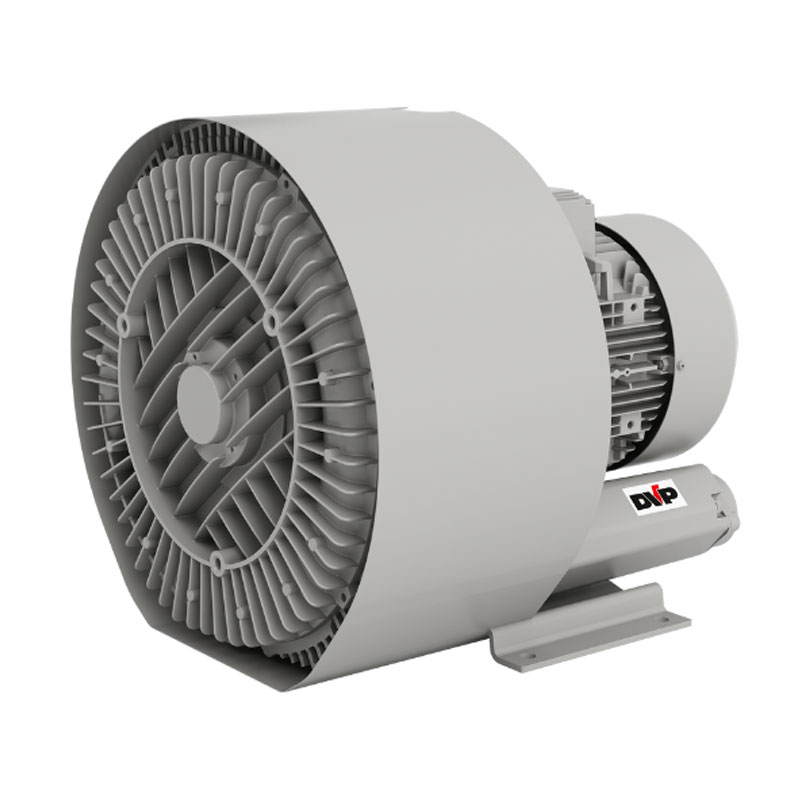
DVP TDL Double-Stage Side Channel Blowers
DVP TDL double-stage side channel blowers deliver clean, oil-free vacuum and pressure where a standard single-stage blower cannot provide enough differential pressure.
Two regenerative impeller stages raise the achievable vacuum and pressure while retaining smooth airflow, non-contact operation and the low-maintenance advantages of side channel technology.
Vacuum Pumps UK is the UK & Ireland Master Agent for DVP Vacuum Technology.
Need help selecting the correct TDL blower?
Send us your required airflow, vacuum or pressure, operating frequency, duty cycle and application details.
We can identify the most suitable model and motor rating for the duty.
Operating Principle
Double Stage
two-stage regenerative compression
Airflow Range
85–620 m³/h
model dependent
Maximum Vacuum
Up to -490 mbar
at 60 Hz, model dependent
Maximum Pressure
Up to +660 mbar
model dependent
Explore the DVP Side Channel Blower Range
Higher Differential Pressure from a Compact Oil-Free Blower
The DVP TDL range is designed for systems that need more suction or delivery pressure than a single-stage side channel blower can economically provide. Air entering the blower passes through two regenerative stages, allowing energy to be added twice before the air leaves the unit.
This staged compression increases the pressure difference between the inlet and outlet without introducing oil into the air stream. The result is a clean, continuous and low-pulsation supply suitable for sensitive machinery and industrial processes.
TDL blowers can be installed for either vacuum or pressure duty and are particularly useful where the system has longer pipe runs, greater resistance, lifting requirements or a demanding operating point.
When Is a Double-Stage Blower the Right Choice?
A double-stage blower is generally selected when the required vacuum or positive pressure exceeds the practical capability of a single-stage model, but the process still benefits from clean, oil-free and contact-free air movement.
Compared with a single-stage unit, the TDL arrangement prioritises differential pressure rather than maximum free-air volume. This makes it well suited to systems with restrictive pipework, deeper suction requirements, elevated discharge pressure or sustained load.
Where very high flow is more important than differential pressure, a single-stage or parallel-stage blower may be more suitable. Where the pressure requirement is still higher, a triple-stage design should be considered.
Key Benefits of DVP TDL Double-Stage Blowers
Higher Vacuum Capability
Two compression stages enable substantially deeper suction than comparable single-stage side channel blowers.
Increased Delivery Pressure
The staged design supports demanding pressure duties, including applications with greater system resistance.
Clean Oil-Free Air
No oil is present in the compression path, helping protect products, pipework and downstream processes.
Continuous-Duty Design
TDL blowers are suited to correctly selected industrial duties requiring dependable, sustained operation.
Low Routine Maintenance
The non-contact impeller principle avoids internal vane wear and reduces routine servicing requirements.
Vacuum or Pressure Operation
The same blower platform can be configured for suction or compression according to the process connection.
Typical Applications for TDL Blowers
DVP TDL double-stage blowers are used where clean air and a stronger pressure differential are more important than maximum unrestricted airflow.
Vacuum Lifting & Holding
Generating stronger suction for lifting devices, vacuum tables, grippers and hold-down systems with controlled leakage.
Pneumatic Conveying
Moving powders, granules and lightweight materials through systems with longer runs or greater resistance.
Packaging Machinery
Supplying vacuum or pressure for forming, handling, sealing, product transfer and automated packaging processes.
Wastewater & Process Aeration
Delivering air against the resistance created by diffusers, liquid depth and connected pipework.
Central Vacuum Systems
Providing distributed suction through manifolds and pipework serving several machines or operating points.
Printing & Paper Processing
Supporting sheet control, suction transport, hold-down and blow-off where stronger vacuum or pressure is required.
How Double-Stage Vacuum and Pressure Operation Works
For vacuum duty, the process is connected to the blower inlet. For pressure duty, the process is connected to the outlet. In both cases, the air passes through two regenerative compression stages before discharge.
The maximum permitted vacuum or pressure depends on the exact model, motor rating, frequency and operating point. Greater system resistance increases the pressure differential and can also increase motor current and air temperature.
The blower must therefore be selected from its performance curve rather than from nominal airflow alone. Relief valves, filters and other accessories may also be required to keep the blower within its safe operating envelope.
Double-Stage TDL Model Specification Table
Select a TDL model by comparing airflow, motor power, achievable vacuum and maximum pressure at the intended operating frequency. Final selection should also consider system resistance, duty cycle, ambient conditions and the required operating point.
| Model | Nominal capacity m³/h — 50 Hz / 60 Hz |
Motor power kW — 50 Hz / 60 Hz |
Vacuum mbar — 50 Hz / 60 Hz |
Maximum pressure mbar — 50 Hz / 60 Hz |
Technical data |
|---|---|---|---|---|---|
| TDL 80 (1~) | 85 / 102 | 0,7 / 0,83 | -210 / -250 | 240 / 250 | Data sheet → |
| TDL 80 (3~) | 85 / 102 | 0,7 / 0,83 | -210 / -250 | 240 / 250 | Data sheet → |
| TDL 120 (1~) | 120 / 145 | 1,1 / 1,3 | -240 / -230 | 280 / 260 | Data sheet → |
| TDL 120 (3~) | 110 / 130 | 1,3 / 1,5 | -280 / -300 | 290 / 400 | Data sheet → |
| TDL 150 (1~) | 150 / 180 | 1,5 / 1,75 | -280 / -250 | 290 / 280 | Data sheet → |
| TDL 150 (3~) | 150 / 180 | 1,6 / 2,05 | -280 / -320 | 280 / 310 | Data sheet → |
| TDL 150-1 (3~) | 150 / 180 | 2,2 / 2,55 | -330 / -350 | 420 / 440 | Data sheet → |
| TDL 210 (3~) | 230 / 275 | 3,0 / 3,45 | -340 / -380 | 410 / 360 | Data sheet → |
| TDL 210-1 (3~) | 230 / 275 | 4,0 / 4,6 | -390 / -410 | 440 / 480 | Data sheet → |
| TDL 310 (3~) | 320 / 380 | 4,3 / 4,8 | -360 / -350 | 380 / 320 | Data sheet → |
| TDL 310-1 (3~) | 320 / 385 | 5,5 / 6,3 | -440 / -440 | 500 / 500 | Data sheet → |
| TDL 310-2 (3~) | 320 / 380 | 7,5 / 8,6 | -440 / -460 | 570 / 660 | Data sheet → |
| TDL 550 (3~) | 520 / 620 | 7,5 / 8,6 | -400 / -360 | 400 / 330 | Data sheet → |
| TDL 550-1 (3~) | 520 / 620 | 11 / 12,6 | -430 / -460 | 660 / 600 | Data sheet → |
| TDL 550-2 (3~) | 520 / 620 | 15,5 / 17,3 | -460 / -490 | 520 / 620 | Data sheet → |
Selecting the Correct TDL Model
The best model is not necessarily the one with the closest nominal airflow. Selection should be based on the required flow at the actual vacuum or pressure level, not at free-air conditions.
Pipe diameter, pipe length, bends, valves, filters, silencers, diffusers, leakage and process restrictions all contribute to system resistance. These factors determine where the blower will operate on its performance curve.
Vacuum Pumps UK can review your application data and recommend a suitable TDL model, motor configuration and accessory package.
Why the Performance Curve Matters
A side channel blower does not deliver the same airflow at every pressure. Available airflow decreases as system resistance and differential pressure rise.
The performance curve shows the relationship between airflow, vacuum or pressure and motor loading. It should be used to confirm that the required operating point falls within the safe continuous-duty area.
Operating too close to the maximum limit can increase temperature and current draw, so a reasonable selection margin is normally advisable.
Accessories and System Protection
Inlet Filters
Help prevent dust and debris from entering the blower and damaging the impeller or housing.
Relief Valves
Limit excessive vacuum or pressure if the system becomes restricted or a valve closes unexpectedly.
Silencers
Reduce inlet or discharge noise where lower sound levels are required around machinery or work areas.
Flexible Connectors
Help isolate vibration and simplify connection between the blower and fixed process pipework.
Installation Considerations
Install the blower on a stable surface with sufficient ventilation around the motor and blower casing. Pipework should be adequately sized, independently supported and arranged to minimise unnecessary restriction.
Ensure the electrical supply, motor connection and overload protection match the motor nameplate. Three-phase rotation must be checked before the blower is placed into service.
Air temperature, ambient temperature, altitude, duty cycle and the nature of the gas should all be considered during selection and installation.
Maintenance and Service Support
TDL blowers require relatively little routine maintenance because the impeller does not contact the housing and no oil is used within the compression path.
Maintenance normally focuses on keeping filters and cooling passages clear, checking electrical connections, inspecting pipework and monitoring the blower for unusual noise, vibration or temperature.
Vacuum Pumps UK can supply replacement blowers, accessories and technical support, while our associated VacAir Superstore workshop provides inspection and repair services for industrial vacuum and pressure equipment.
Why Buy DVP TDL Blowers from Vacuum Pumps UK?
Vacuum Pumps UK is the UK & Ireland Master Agent for DVP Vacuum Technology, providing direct access to DVP product knowledge, genuine equipment and application support.
Our team can help compare airflow and differential pressure requirements, identify the correct motor arrangement and advise on filters, relief valves, silencers and installation considerations.
For a replacement blower or a new application, send us the required duty and we will help match it to the most suitable TDL model.
Frequently Asked Questions
What is the difference between a TSL and TDL blower?
A TSL blower uses a single regenerative stage and generally prioritises higher airflow at moderate differential pressure. A TDL blower passes the air through two stages to achieve greater vacuum or pressure.
Can a TDL blower provide both vacuum and pressure?
Yes. Connecting the process to the inlet creates vacuum, while using the outlet supplies positive pressure. The allowable operating limits depend on the selected model.
Are DVP TDL blowers oil free?
Yes. No oil is used within the compression path, so the blower delivers clean air without oil carryover from the pumping chamber.
Can the blower operate continuously?
TDL blowers can be used for continuous industrial duty when the model is correctly selected, adequately cooled and operated within its permitted performance envelope.
What information is needed to select a TDL blower?
Provide the required airflow at the operating vacuum or pressure, supply frequency, duty cycle, ambient conditions, gas details and information about the connected pipework or process.
Need a DVP Double-Stage Side Channel Blower?
Contact Vacuum Pumps UK for prices, availability, performance curves and technical selection advice.
Send us the required airflow, vacuum or pressure and application details and we will recommend the most suitable TDL model.