DVP CPA Triplex Centralised Vacuum Systems
DVP CPA Triplex systems combine three oil lubricated rotary vane vacuum pumps, a PLC control panel and a vertical vacuum receiver into a complete centralised vacuum system for continuous industrial use.
The range provides nominal capacities from 75 to 915 m³/h and is designed to maintain a stable vacuum supply across multiple machines, production lines or factory processes.
Automatic pump sequencing allows the system to match operating capacity to actual vacuum demand, helping reduce unnecessary energy consumption while retaining standby capacity for peak demand and maintenance.
Vacuum Pumps UK is the UK & Ireland Master Agent for DVP Vacuum Technology.

Planning a new factory vacuum system or replacing an existing central vacuum plant?
Send us your required vacuum level, peak demand, number of connected machines, pipework information and future expansion plans.
Our technical team can assess both standard CPA systems and bespoke multi-pump layouts.
System Type
Centralised Vacuum
complete industrial plant
Pump Configuration
Three LC Pumps
automatic duty rotation
Capacity Range
75–915 m³/h
50 Hz nominal capacity
Control System
PLC Touchscreen
remote monitoring ready
CPA Triplex System Overview
A centralised vacuum system supplies vacuum to multiple machines or process points from one dedicated vacuum plant. Instead of installing and maintaining separate pumps at every machine, a common vacuum line connects production equipment to the central system.
The DVP CPA Triplex range uses three LC oil lubricated rotary vane vacuum pumps mounted around a vertical vacuum receiver. The PLC controller monitors system pressure and automatically starts or stops pumps according to demand.
This arrangement provides a stable vacuum supply, shared running hours, reduced unnecessary energy use and standby capacity for peak production periods or planned maintenance.
DVP CPA Triplex System Range
The table below shows the standard CPA Triplex configurations. Each system combines three DVP LC oil lubricated rotary vane pumps with a vertical vacuum receiver and PLC control system.
Final selection should be based on average vacuum demand, peak simultaneous demand, required system pressure, receiver capacity, pipework layout and planned future expansion.
| System | Primary pumps | Tank capacity dm³ |
Nominal capacity m³/h 50Hz / 60Hz |
Final pressure mbar absolute |
Motor power kW 50Hz / 60Hz |
| CPA 3 x 25/300V | 3 x LC25 | 300 | 75 / 87 | 10 | 3 x 0.75 / 3 x 0.90 |
| CPA 3 x 25/500V | 3 x LC25 | 500 | 75 / 87 | 10 | 3 x 0.75 / 3 x 0.90 |
| CPA 3 x 40/500V | 3 x LC40 | 500 | 120 / 144 | 10 | 3 x 1.1 / 3 x 1.35 |
| CPA 3 x 60/500V | 3 x LC60 | 500 | 180 / 216 | 10 | 3 x 1.5 / 3 x 1.8 |
| CPA 3 x 10⁶/500V | 3 x LC106 | 500 | 318 / – | 10 | 3 x 2.2 / – |
| CPA 3 x 10⁶/1000V | 3 x LC106 | 1000 | 318 / – | 10 | 3 x 2.2 / – |
| CPA 3 x 151/1000V | 3 x LC151 | 1000 | 453 / – | 10 | 3 x 3.3 / – |
| CPA 3 x 205/1000V | 3 x LC205 | 1000 | 615 / – | 10 | 3 x 5.5 / – |
| CPA 3 x 305/1000V | 3 x LC305 | 1000 | 915 / – | 10 | 3 x 7.5 / – |
How a CPA Triplex System Works
Vacuum Receiver
The vertical welded steel receiver provides stored vacuum capacity and helps smooth sudden changes in demand from connected production equipment.
PLC Pressure Control
An absolute pressure sensor monitors the vacuum level in the receiver and communicates continuously with the PLC control panel.
Automatic Pump Staging
The controller starts additional pumps when demand rises and switches them off when the required vacuum can be maintained with fewer pumps.
Duty Rotation
Pump priority is rotated automatically so operating hours and mechanical wear are distributed more evenly across the three pumps.
Why Use Three Pumps Instead of One Large Pump?
Lower Energy Use
During periods of reduced demand, the system can operate only the number of pumps required rather than running one oversized pump continuously.
Built-In Standby Capacity
Depending on actual factory demand, one pump can often be isolated for maintenance while the remaining pumps continue supplying vacuum.
Even Running Hours
Automatic sequencing prevents one pump from carrying the entire workload and helps distribute service intervals across the installation.
Better Peak-Demand Response
Additional pumps are brought online automatically when several machines demand vacuum at the same time.
Designed to Protect Production Uptime
In a production-critical factory, the cost of losing vacuum can greatly exceed the cost of the vacuum equipment itself. A correctly sized multi-pump system provides valuable operating resilience.
If Pump A requires an oil change, routine service or repair, it can be isolated using its individual inlet valve. The PLC can then call on Pumps B and C to maintain vacuum within the receiver, provided the remaining capacity is sufficient for current production demand.
Integrated non-return valves help retain vacuum in the receiver when individual pumps are stopped, while isolation valves allow maintenance without unnecessarily opening the complete system.
Standby performance and uninterrupted operation depend on selected system capacity and actual factory demand, so redundancy should be considered during initial system design.
Intelligent PLC Control and Remote Monitoring
The CPA Triplex control system automatically optimises pump operation according to vacuum demand. This reduces unnecessary running hours and provides operators with clear information about system condition and performance.
› Touchscreen PLC display
› Eight selectable operating languages
› Automatic pump staging and duty rotation
› Internet connection for remote access
› Access from compatible computers and smartphones
› Remote assistance capability
› Sensor, alarm and user-login data
› Data storage and download
› Email alerts
› Customised parameter management
Bespoke Centralised Vacuum System Design
The standard CPA Triplex range provides a comprehensive selection of three-pump systems, but not every industrial installation can be served by a standard catalogue layout.
Vacuum Pumps UK can also assist with bespoke centralised vacuum systems configured around available plant-room space, required capacity, receiver volume, production-critical redundancy and future expansion requirements.
Custom Layouts
Pump frames, receiver position, control-panel location and service access can be considered around the available installation space.
Receiver Selection
Larger or alternative receiver arrangements can be considered where additional stored vacuum or a different physical layout is required.
Pump Configuration
The number and size of pumps can be selected to provide required capacity, standby resilience and planned future expansion.
Control Integration
PLC functions can be considered alongside remote monitoring, factory control requirements, alarm outputs and operating priorities.
Bespoke Installation
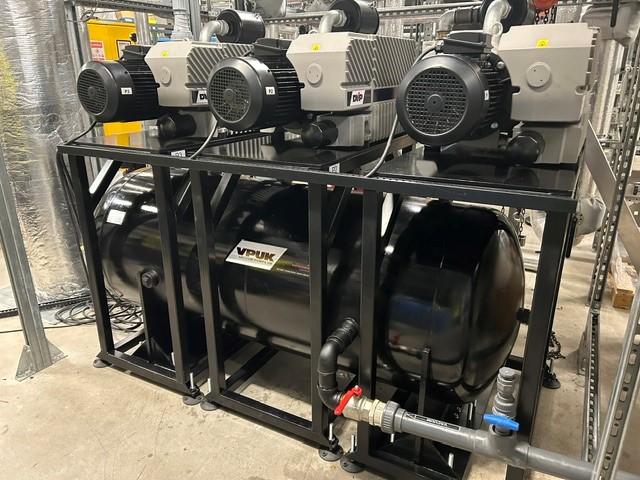
Central Vacuum System for a Leading UK Aerospace Manufacturer
This bespoke centralised vacuum installation was supplied for continuous operation within a major UK aerospace manufacturing facility.
The system incorporates multiple DVP rotary vane vacuum pumps, a large vacuum receiver and intelligent electronic control to provide a stable vacuum supply across the production process.
Automatic duty rotation shares operating hours across the pumps, while standby capacity helps protect production if a pump is isolated for planned servicing or unexpectedly becomes unavailable.
The installation demonstrates how DVP pump technology can be configured into a bespoke system for demanding, production-critical manufacturing.
Typical Applications
CPA Triplex systems are designed for industrial sites where several machines, process lines or production areas require a shared and dependable vacuum supply.
› Aerospace and advanced manufacturing
› Printing and paper handling
› Plastics processing and forming
› Composite manufacturing
› Woodworking and CNC vacuum hold-down
› Automated handling and lifting systems
› Medical and laboratory equipment manufacturing
› OEM production machinery
› General industrial vacuum distribution
Information Required to Design the System
A centralised vacuum plant should be sized from the complete factory demand rather than simply adding together the nominal capacities of existing pumps.
› Number and type of connected machines
› Required vacuum level at each user
› Average vacuum demand
› Peak simultaneous demand
› Current pump sizes and operating hours
› Pipework lengths and diameters
› Available plant-room space
› Required standby or redundancy level
› Available electrical supply
› Planned production expansion
CPA Triplex Frequently Asked Questions
What is a DVP CPA Triplex system?
It is a complete centralised vacuum system combining three DVP LC oil lubricated rotary vane pumps, a vertical vacuum receiver, filtration, isolation valves, pressure monitoring and intelligent PLC control.
Why are three vacuum pumps used?
Three pumps allow capacity to be staged according to demand, running hours to be rotated and standby capability to be designed into production-critical installations.
Does the system run all three pumps continuously?
No. The PLC starts and stops pumps according to system vacuum demand and selected control parameters.
Can one pump be serviced while the system is operating?
Potentially, yes. Each pump has an isolation valve and non-return valve. Whether production can continue with one pump isolated depends on remaining capacity and actual factory demand.
Can Vacuum Pumps UK supply a bespoke layout?
Yes. Bespoke layouts can be considered where a standard CPA arrangement does not suit the required capacity, receiver size, installation space, redundancy level or future expansion plan.
Does Vacuum Pumps UK provide service support?
Yes. Vacuum Pumps UK can assist with system selection and technical advice, while servicing and repairs are available through our sister company VacAir Superstore.
Planning a Centralised Vacuum System?
Contact Vacuum Pumps UK for CPA Triplex prices, technical advice, standard system selection and bespoke multi-pump vacuum plant design.
Send us your factory vacuum requirements and we will help identify the most appropriate system.